
Gold Jewellery vs Gold Bars and Coins: Which Is the Better Investment in Singapore?

Gold jewellery and gold bullion are often talked about as if they are the same purchase with different packaging. They are not. One is designed to be worn and given, the other to be held as close to pure metal value as possible, and the two follow different pricing, tax and resale rules in Singapore. This guide compares them directly to help you decide which vehicle matches what you're trying to achieve.
Two Different Reasons People Buy Gold, and Why That Matters
Before comparing products, it helps to separate the two underlying motives that usually sit behind a gold purchase.
Buying Gold to Wear vs Buying Gold to Hold
Gold jewellery is bought for a mix of reasons: to wear, to gift, to mark an occasion, and, to some extent, to hold value. Gold bars and coins are bought almost entirely for the last reason alone. This distinction matters because a piece optimised for wearability, with a design, a workmanship charge and a specific weight for comfort, is never optimised for capital efficiency in the same way a plain investment bar is. Neither approach is wrong; they solve different problems.
Why This Question Has Become More Common in Singapore
More buyers in Singapore have been weighing this choice directly in recent years. Reporting by Malay Mail, citing CNA and World Gold Council data, found that gold jewellery sales by volume in Singapore fell 8 per cent year-on-year in the third quarter of 2025, while demand for gold bars and coins rose 47 per cent over the same period, with the Singapore Jewellers Association pointing to the GST exemption on investment-grade bullion as one factor behind the shift. This mirrors a broader pattern the World Gold Council has tracked globally: bar and coin demand strengthening even as jewellery volumes soften in a high gold price environment. None of this tells you what you personally should do; it simply explains why the comparison has become more common.
How Gold Jewellery Works as an Investment
Understanding jewellery's mechanics on their own terms makes the later comparison more meaningful.

What You're Really Paying For
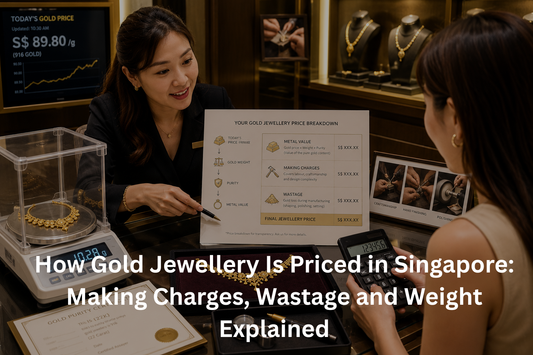
Jewellery pricing in Singapore generally follows gold weight multiplied by the daily rate, plus a making or workmanship charge, plus GST. That workmanship charge covers design, labour and a wastage allowance for metal lost during fabrication. You pay it upfront, and you typically don't recover it if you later sell or melt down the piece, since a buyer assessing scrap or resale jewellery generally prices the metal content, not the craftsmanship.
Purity and Investment Value
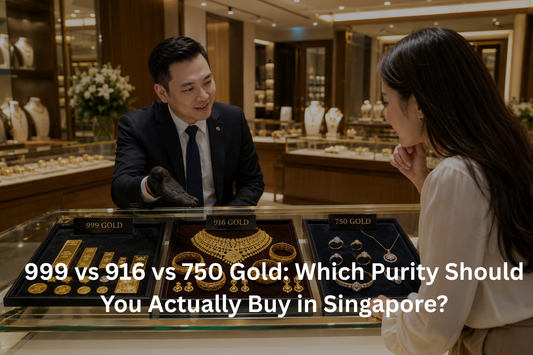
Purity affects how much of a piece's price reflects pure gold content versus alloy and workmanship. 916 (22K) and 999 (24K) are the most common purities sold in Singapore, and a dedicated purity comparison guide covers the practical differences between them. For investment purposes, higher purity generally keeps a larger share of the price tied to metal value, though workmanship charges still apply regardless of purity.
The GST Treatment of Jewellery
Gold jewellery does not qualify for GST exemption in Singapore under current rules, unlike qualifying investment-grade bars and coins. This is worth verifying against current IRAS guidance at the time of purchase, since tax treatment can be updated, but as things stand, jewellery is standard-rated while bullion meeting specific criteria is not.
How Gold Bars and Coins Work as an Investment
Bullion is priced and taxed differently from jewellery, largely because it is designed for a different purpose.

What "Investment Precious Metals" (IPM) Means in Singapore
IPM is a defined regulatory category, not simply any gold product. According to IRAS, a gold bar, ingot, or wafer must be at least 99.5% pure, capable of being traded on the international bullion market, and produced by a refiner accredited on the London Bullion Market Association's Good Delivery list (or endorsed by Enterprise Singapore) to qualify. Gold coins must meet the same purity threshold and be, or have been, legal tender in their country of origin, and only coins on a prescribed list qualify; collector or proof versions generally do not. Gold jewellery never meets this definition, regardless of its purity.
Premiums on Bars vs Coins
As a general pattern, bars tend to carry lower premiums over the spot price than coins of the same weight, since coins typically involve more intricate minting, design work and, for legal-tender coins, government certification. Smaller bars and coins also tend to carry higher premiums per gram than larger ones, because fixed refining, minting and packaging costs are spread across less metal. This is a general market pattern, not a guaranteed outcome for every product or dealer.
Where Bars and Coins Are Bought and Stored
In Singapore, UOB is currently the only bank selling physical gold bullion over the counter, alongside several specialised bullion dealers. Storage is a real, ongoing consideration: options include a home safe, a bank safe deposit box (typically uninsured unless arranged separately), or a dedicated vaulting service, each with different costs and trade-offs around access, insurance and security.
Comparing the Two Head-to-Head

Set side by side, jewellery and bullion differ most clearly across five practical factors.
|
Factor |
Gold Jewellery |
Gold Bars and Coins |
|
Upfront cost |
Gold weight + making charge + GST |
Close to spot price + a smaller premium |
|
Tax treatment |
Standard-rated for GST |
GST-exempt if it meets IPM criteria |
|
Liquidity and resale |
Often resold near melt value; making charge rarely recovered |
Generally easier to value and resell near spot price |
|
Utility |
Wearable, giftable, sentimental value |
Minimal utility beyond value storage |
|
Storage |
Usually worn or kept at home |
May require a safe, deposit box or vault at scale |
Upfront Cost and Premium
Jewellery's making charge is a real, ongoing cost of the format, applying every time a piece is bought, whereas bullion premiums, while still a cost, sit much closer to the underlying gold price.
Tax Treatment
The GST distinction above is one of the clearest, most concrete differences between the two, since it applies at the point of purchase regardless of how the gold is later used or sold.
Liquidity and Resale
Bullion is generally easier to value and resell close to spot price, since a buyer is assessing a standardised, easily verified product. Jewellery resale often recoups only something closer to melt value, since fabrication and workmanship charges are usually not reflected in what a buyer will pay back. This is a general pattern rather than a guaranteed outcome; branded, antique or design-led pieces can sometimes fetch more through specialist resale channels.
Utility and Sentimental Value
Jewellery's non-financial value (wearability, gifting suitability, sentimental association with an occasion) is a legitimate reason it may still make sense even where its "investment efficiency" is lower than bullion. This isn't a weakness in the comparison; it simply reflects that jewellery solves a different problem than pure capital preservation.
Storage, Security, and Insurance
Holding either form at meaningful scale carries a security burden. A piece worn occasionally and kept at home is a modest, familiar risk for most households; a meaningful bullion holding is a different proposition, and buyers accumulating bars or coins at scale generally need insured storage rather than treating a drawer or small safe as sufficient.
Which Might Suit Different Types of Buyers
There is no single correct answer; the best fit depends on what you are trying to achieve.
If You Want Pure Capital Preservation
A buyer prioritising minimal premium, straightforward resale and GST efficiency is generally better served by investment-grade bars or coins than by jewellery, since jewellery's workmanship charge works against that specific goal.
If You Want Gold You Can Wear or Gift
A buyer for whom wearability, gifting, or a specific occasion matters is likely to find jewellery's dual utility (part adornment, part value) more relevant than bullion's slightly better investment efficiency, since that efficiency comes at the cost of everyday usability.
If You Want Both
Some buyers hold a mix, treating jewellery as a personal or sentimental holding and bullion as a separate, more efficient store of value. Others lean toward higher-purity (999) jewellery as a partial compromise. This is a personal allocation decision that depends on individual goals, not a recommendation either way.
Common Misconceptions About Gold as an Investment
A few oversimplifications come up often enough to warrant direct addressing.
"All Gold Purchases Are GST-Exempt"
This isn't accurate. Only bars, ingots, wafers and prescribed coins that meet the specific IPM purity, refiner and market-tradability criteria qualify; gold jewellery, regardless of purity, does not.
"Jewellery Always Retains Its Full Purchase Price"
Jewellery's purchase price includes a making charge that generally is not recovered on resale. A piece bought today at full retail price will typically be valued closer to its gold content alone if sold or melted down later.
"Bullion Has No Costs Beyond the Purchase Price"
Bullion still carries real costs: a premium over spot at purchase, potential storage or insurance costs at scale, and a buyback spread when selling, since dealers generally buy back below their current selling price. It is a more capital-efficient format than jewellery, not a cost-free one.
Practical Steps Before You Buy Either
A few concrete checks reduce the risk of an unpleasant surprise later, whichever format you choose.
Verifying Purity and Certification
For jewellery, check for a proper purity hallmark; in Singapore, the Singapore Assay Office operates the national hallmarking scheme. For bars and coins, confirm the refiner's accreditation and, for coins, that they appear on the prescribed IPM list if GST exemption matters to your decision.
Confirming Buyback Terms in Advance
Buyback policies and pricing bases vary significantly between dealers and retailers, and some offer better rates for items bought and sold at the same shop. Asking about buyback terms before you buy, rather than after, avoids relying on assumptions when it comes time to sell.
Matching the Purchase to Your Time Horizon
A buyer who may need to liquidate within a year or two has different priorities than one holding for a decade or gifting with no resale intention at all. Short-term liquidity needs generally favour formats that are easy to value and resell quickly; longer-term holding or gifting intentions leave more room for jewellery's dual utility to matter. This is a general consideration, not financial advice tailored to any individual's circumstances.
Frequently Asked Questions
Is 999 Gold Jewellery Treated the Same as a Gold Bar for Tax Purposes?
No. Purity alone does not qualify jewellery for GST exemption; the product's form matters too. A 999 pure bar or coin from an accredited refiner can qualify as IPM, while 999 jewellery, however pure, cannot, since it falls outside the defined bar, ingot, wafer or coin categories.
Can I Convert Jewellery Into Bullion, or Vice Versa?
Not directly. In practice, jewellery is generally sold closer to melt value, and bullion is bought separately, rather than one being physically converted into the other. Treat them as two distinct products rather than interchangeable forms of the same asset.
Does Buying From a Bank Differ From Buying From a Retailer?
Yes, in range and service rather than underlying product quality. A bank such as UOB offers a narrower, standardised bullion range through a banking counter, while specialised bullion dealers and jewellery retailers typically offer a wider selection and, in some cases, additional services such as storage. The right choice depends on convenience and which services you value.
Conclusion
Gold jewellery and gold bullion answer different questions. Jewellery blends adornment, gifting value and a store of value, at the cost of a making charge rarely recovered on resale. Bars and coins prioritise capital efficiency, with lower premiums, GST exemption where criteria are met, and generally easier resale, at the cost of everyday usability. Neither is a universally "better" investment; the right choice depends on whether you are optimising for wearability and sentiment, for capital preservation, or a deliberate mix of both.
Tags:
Previous
Gold Jewellery for a Newborn or Baby's First Month: A Singapore Gifting Guide
Next
How to Store Gold Jewellery at Home Safely in Singapore
Related articles

-
Sep 21 2026