




Gold Price in Singapore 2026: What Drives It Up and Down

Why the Gold Price You See Online Is Never What You Pay at the Counter
The Gap Between Spot Price and Singapore Retail Price
Most buyers in Singapore have experienced this: they check the price online, see $90 per gram, arrive at a jewellery counter, and find the piece they want priced at $110 per gram or more. The difference is not a hidden markup. It is the result of several distinct pricing layers that stack between the international market and the Singapore jewellery shop.
Understanding the Layers: Spot Price, Currency Conversion, Premium, and Making Charge
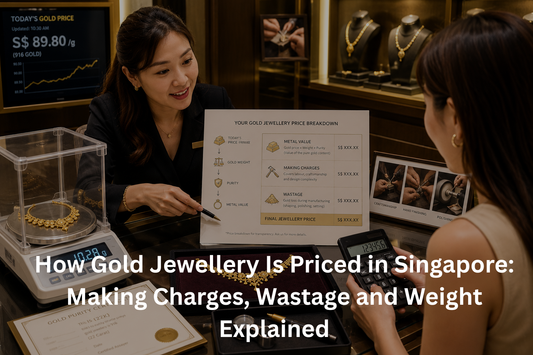
The international spot price, expressed in USD per troy ounce, is the foundation. That figure is converted from USD to SGD at the current exchange rate, adding currency variation as a second variable. A small dealer premium above spot covers acquisition and logistics costs. On top of all of this sits the making charge: the workmanship fee that varies by design complexity, has nothing to do with the metal's market price, and does not recover on resale. Understanding these four components tells you exactly why the counter price is always higher than the figure you found online.
How Gold Is Priced Globally: The Foundation Before the Singapore Price

What the Gold Spot Price Is and Where It Comes From
The spot price is the current market price for immediate delivery of one troy ounce of the metal, expressed in USD. It is set through continuous trading on the London Bullion Market Association benchmark and futures markets, including COMEX in New York. It changes continuously during trading hours and opens at a new level each morning based on overnight trading activity.
Why Gold Is Priced in US Dollars and How That Affects Singapore Buyers
The metal is denominated in USD as a legacy of the Bretton Woods system. For a buyer paying in SGD, this means exposure to two variables simultaneously: the price in USD and the SGD/USD exchange rate. A falling USD can inflate the SGD price even when the international spot figure has not moved.
The XAU/USD Relationship and What Singapore Buyers Should Track
XAU/USD is the primary benchmark: the price of one troy ounce expressed in US dollars. To convert to a Singapore gram price, divide the XAU/USD figure by 31.1 (grams per troy ounce) and multiply by the prevailing SGD/USD rate. This calculation gives the pure gold content price per gram before any premium or making charge, and allows direct comparison with a quoted retail price.
The Key Drivers That Push Gold Prices Up

US Dollar Weakness and the Inverse Relationship with Gold
The metal and the US Dollar Index (DXY) typically move in opposite directions. When the USD weakens, it becomes cheaper in other currencies, global demand rises, and the USD price follows upward.
Inflation and Why Investors Treat Gold as a Store of Value
The commodity cannot be printed or devalued by a central bank. During periods of elevated or unexpected inflation, investment demand increases as investors seek assets that preserve purchasing power.
Interest Rates: Why Falling Rates Support Gold
The metal yields nothing. When interest rates are low, the cost of holding it instead of interest-bearing assets is minimal. Rate cut cycles and expectations of future cuts have historically been among the most reliable drivers of price appreciation.
Geopolitical Risk and Crisis Demand
Gold is treated as a safe-haven asset during geopolitical stress. Crisis-driven price spikes are real but often temporary: prices often give back part of the crisis gain once the immediate threat recedes.
Central Bank Gold Buying: How Government Reserve Decisions Affect Price
The World Gold Council tracks significant accumulation by central banks in China, India, Turkey, and other emerging market economies. This structural demand supports prices independently of retail and investment buying cycles.
ETF Flows and Institutional Demand
When institutional money flows into gold-backed exchange-traded funds, it creates measurable buying pressure. Rising ETF holdings signal growing institutional confidence and tend to support the price.
The Key Drivers That Push Gold Prices Down

A Strengthening US Dollar
A rising DXY makes the metal more expensive in non-USD currencies, reducing global demand and suppressing the USD price.
Rising Real Interest Rates and Their Effect on Non-Yielding Assets
Real interest rates are nominal rates minus inflation. When they rise, the opportunity cost of holding a non-yielding asset increases and investment capital tends to move toward interest-bearing alternatives.
Improved Risk Appetite and Stock Market Confidence
When investors feel confident about economic growth, demand for safe-haven assets tends to fall. This relationship is not absolute, but it is a recurring pattern during periods of strong equity market performance.
Reduced Geopolitical Tension
The de-escalation of a geopolitical crisis tends to unwind the safe-haven premium that drove prices up. Price spikes built on geopolitical fear often partially reverse when the immediate threat recedes.
Profit-Taking and Speculative Selling
Large-scale selling by institutional investors or futures traders who entered at lower price levels can create sharp declines. These corrections do not always reflect a change in underlying demand fundamentals.
The table below summarises all key drivers for quick reference.
|
Driver |
Direction |
Core Mechanism |
|
USD weakness (DXY falls) |
Up |
Metal cheaper in other currencies, global demand rises |
|
Inflation above expectations |
Up |
Safe-haven demand, purchasing power protection |
|
Interest rate cuts |
Up |
Opportunity cost of holding the metal falls |
|
Geopolitical crisis |
Up |
Flight to safety |
|
Central bank buying |
Up |
Structural demand from sovereign reserves |
|
ETF inflows |
Up |
Institutional buying pressure |
|
USD strength (DXY rises) |
Down |
Metal more expensive globally, demand falls |
|
Rising real interest rates |
Down |
Opportunity cost of holding non-yielding assets increases |
|
Strong risk appetite |
Down |
Capital moves to equities and growth assets |
|
Geopolitical de-escalation |
Down |
Safe-haven premium unwinds |
|
Speculative profit-taking |
Down |
Technical correction, not a fundamental shift |
Singapore-Specific Factors That Affect the Gold Price You Pay

The SGD/USD Exchange Rate: How Currency Moves Add a Second Variable
When the SGD weakens against the USD, Singapore buyers pay more in local currency even if the international price has not moved. The Monetary Authority of Singapore manages the SGD through an exchange rate policy band rather than interest rate adjustments, which means SGD movement patterns differ from typical currency dynamics. Tracking both XAU/USD and the SGD/USD rate together gives a more complete picture locally than either figure alone.
Chinese New Year and Seasonal Demand: Why Making Charges Rise Predictably
The Chinese New Year gifting season creates a predictable demand surge for jewellery here. Making charges at some retailers increase during this period even when the underlying content price is unchanged. Buying in the weeks before the CNY peak rather than during it often produces a more favourable total price.
How 916 and 999 Gold Are Priced Differently in Singapore
Both 916 (91.6 percent pure) and 999 (99.9 percent pure) are priced by multiplying their content weight by the current market price for the relevant purity. Per gram of actual metal content, the two are comparable. The practical difference is physical: 999 is softer and more susceptible to surface damage under daily wear, which affects resale condition over time.
Why the Same Gold Price Produces Different Prices at Different Shops
What Making Charges Are and Why They Vary
Making charges cover workmanship: the labour, skill, and design complexity involved in producing the piece. They are not tied to the metal's content price and are not recoverable on resale. They vary by design complexity and retailer positioning. Licensed retailers such as GM Collections present content pricing separately from making charges in their quotations, allowing buyers to evaluate each component independently.
How to Calculate the Gold Content Value of a Piece Before You Buy
Multiply the weight in grams by the current price per gram for the relevant purity, then add the making charge. This formula gives the total price and allows direct comparison across retailers. Focus on the content value relative to the total price, not just the headline figure.
What the Gold Price Environment Looks Like in 2026
Beyond the local pricing mechanics, the macro environment that shapes the global price is equally important for buyers thinking about timing.
The Key Factors Shaping Gold in Late 2025 and Early 2026
Several price-supportive conditions remained in place as 2026 began. Global inflation was moderating but remained above central bank targets. The US Federal Reserve was navigating rate normalisation. Geopolitical uncertainty persisted across multiple regions, and central bank accumulation of reserves continued. These conditions collectively placed prices at or near multi-year highs heading into the year.
The Three Scenarios That Could Drive Gold Higher in 2026
The first is a faster-than-expected US rate cutting cycle, reducing the opportunity cost of holding the metal. The second is an escalation of geopolitical conflict in a region with commodity or economic significance. The third is sustained USD weakness driven by US fiscal concerns or continued global reserve diversification away from dollar assets.
The Three Scenarios That Could Pressure Gold Lower in 2026
The first is inflation falling faster than expected, allowing rates to remain elevated without recession. The second is a strong risk-on environment driven by productivity growth or economic outperformance that redirects capital from safe havens to equities. The third is a speculative de-leveraging event in futures markets that produces a technical correction independent of fundamentals.
Why Nobody Can Reliably Predict Gold Prices and What That Means for Buyers
Even the most informed analysts have consistently failed to predict price direction over 12-month horizons with reliability. The more useful question for a buyer is not whether to time the market but whether the current price, given a fair making charge, is reasonable relative to the purpose of the purchase.
How to Use Gold Price Knowledge to Make Better Buying Decisions

The Difference Between Buying Gold Jewellery and Buying Investment Gold
A jewellery buyer pays content value plus a making charge. An investment buyer pays a smaller premium over spot with no making charge. The making charge means jewellery buyers need a larger price increase to break even on resale. This does not make jewellery a poor choice: it simply means the purchase serves both a wearing purpose and a store-of-value purpose, and should be evaluated on both dimensions.
What Conditions Suggest Buying Sooner Rather Than Later
When multiple price-supportive factors align simultaneously, such as falling rates, rising inflation expectations, and USD weakness, buying sooner rather than later protects against further price increases. Seasonal demand pressure approaching a CNY or peak gifting period is a second practical reason not to delay.
What Conditions Suggest Waiting Before Making a Large Purchase
A recent crisis-driven spike that may partially reverse, a period of elevated seasonal making charges, or an unusually weak SGD are all conditions where waiting a few weeks could produce a meaningfully better total price.
The Making Charge Consideration That Most Buyers Overlook
A buyer who waits for the price to fall five percent but pays a ten percent higher making charge than a comparable retailer has not saved money. Total price per gram of content, not headline price, is the correct comparison metric. Checking the making charge across two or three licensed retailers is a more productive exercise than attempting to time the spot market.
Conclusion
Gold prices in Singapore reflect a stack of variables: the international USD spot price, the SGD/USD exchange rate, a small dealer premium, and a making charge that varies by retailer and design. The key upward drivers are USD weakness, inflation, rate cuts, geopolitical stress, and central bank buying. The key downward drivers are USD strength, rising real interest rates, improved risk appetite, and speculative selling. In 2026, the direction of the US rate cycle and the USD trajectory are the two variables most worth monitoring. For Singapore jewellery buyers, the most practical application of this knowledge is the ability to evaluate whether a quoted price is fair at any point in the cycle, rather than waiting for a predicted low that may never arrive.
Tags:
Previous
Is Now a Good Time to Sell Your Gold Jewellery? How to Evaluate Resale Value in Singapore
Next
Is Buying Gold Jewellery a Good Investment in Singapore?
Related articles

-
Sep 21 2026