
Is Buying Gold Jewellery a Good Investment in Singapore?

Why the Question Has Two Very Different Answers Depending on What You Mean by Investment
The Difference Between Gold as an Investment and Gold Jewellery as a Purchase
Gold and jewellery are not the same financial proposition. The metal has a well-documented long-term value track record. A specific piece of jewellery has a price that includes the metal's value plus a workmanship fee. These two components behave very differently when you sell.
A buyer who understands what they are actually paying for and plans accordingly can use jewellery as a genuine store of value over time. A buyer who expects it to perform like a bullion bar or ETF will be disappointed when they try to sell.
Why Most Gold Jewellery Cannot Deliver Investment-Grade Returns
The structural barrier is the making charge: the workmanship fee paid at purchase that is not recovered on resale. Resale buyers pay for content weight at the current market price. They do not reimburse the design, craftsmanship, or brand positioning that made up part of the original retail price. This is not unfair practice. It is simply how jewellery pricing works, and most buyers do not fully understand it until they try to sell.
Understanding the Investment Equation for Gold Jewellery

What You Actually Pay: Gold Content Plus Making Charge
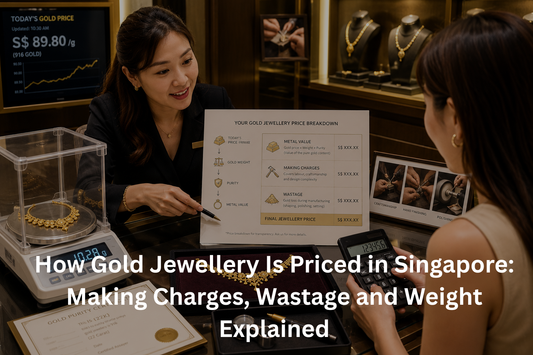
Every jewellery price contains two components. The first is the gold content value: the weight of the piece in grams multiplied by the current price per gram for the relevant purity. The second is the making charge: the workmanship fee that varies by design complexity and retailer. A simple 916 gold chain may carry a making charge of $80 to $150. An intricate bracelet with detailed craftsmanship may carry $300 to $500 or more.
What You Actually Recover on Resale: Gold Content Value Only
Resale buyers, whether jewellers, pawn shops, or refiners, calculate their offer based on content weight and the current market price. They do not factor in the original making charge, design premium, or brand. The resale price is essentially the scrap value of the metal.
The Making Charge as a Sunken Cost: What It Means for Your Return
A Real-World Example: What a $2,000 Gold Necklace Is Actually Worth on Resale
Consider a 916 gold necklace priced at $2,000, weighing 20 grams. At a current price of $92 per gram of pure gold, the gold content is 18.32 grams worth approximately $1,685, rounded to $1,700. The making charge is $300. On resale at the same price per gram, the buyer recovers approximately $1,600 to $1,700 after resale handling costs. For the seller to break even on the original $2,000, the price per gram of pure gold must rise from $92 to approximately $109. That is an increase of roughly 18 to 19 percent just to recover the purchase price.
How to Calculate Your Break-Even Gold Price Before You Buy
Divide the total purchase price by the pure gold weight in grams. For this necklace: $2,000 divided by 18.32 grams equals approximately $109 per gram of pure gold. The current price is $92 per gram. The price must rise by approximately 18 to 19 percent before this buyer breaks even on resale. Apply this formula to any piece before committing. A lower making charge means a lower break-even threshold and a shorter time to recovery.
How Gold's Long-Term Track Record Applies to Jewellery

Gold's Historical Value Track Record and What It Actually Shows
The World Gold Council data shows that gold has broadly appreciated over 20 and 30-year periods, though with significant multi-year stretches of flat or declining prices. It has served as a long-term store of value rather than a short-to-medium-term growth asset.
Why the Metal's Performance and Your Jewellery Investment Performance Are Different Numbers
Even if the metal rises 20 percent over three years, a buyer who paid a 15 percent making charge is only 5 percent ahead before resale costs. The longer you hold, the more price appreciation has time to absorb the making charge cost.
The Condition That Must Be Met for Gold Jewellery to Deliver a Positive Return
Three conditions must align: the price must rise by more than the making charge percentage from your purchase price; the piece must be in resaleable condition; and your holding period must be long enough for appreciation to cover the sunken cost. A minimum holding period of 8 to 10 years is typically required for buyers to recover their full purchase price in nominal terms and begin accumulating real return.
Gold Jewellery vs Other Forms of Gold Investment in Singapore

The table below compares gold jewellery against other vehicles available in Singapore.
|
Investment Type |
Making Charge |
Tracks Spot Price |
Liquidity |
Best Suited For |
|
Gold jewellery |
Yes, 10 to 25% typical |
No, resale is below spot |
Low |
Dual-purpose: wear and value store |
|
Physical bullion |
No |
Very close to spot |
Moderate |
Pure investment, long-term hold |
|
Gold ETF |
No |
Yes, with minimal fees |
High |
Efficient financial gold exposure |
|
Bank gold savings |
No |
Close, with spread |
High |
Low-effort price exposure |
Physical Bullion: The Purest Gold Investment and Its Trade-Offs
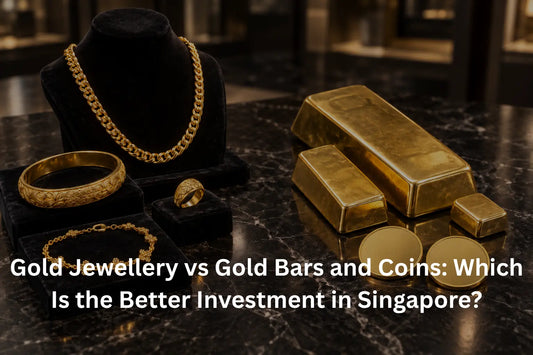
Bullion bars and coins trade close to spot price with minimal premium and no making charge. They cannot be worn or gifted in the same way, require secure storage, and need authentication on resale. They are the right choice for buyers whose sole objective is price exposure.
Gold ETFs and Digital Gold: The Most Efficient Investment Vehicle
Gold ETFs track the spot price with the lowest cost and highest liquidity of any vehicle in this category. MoneySense Singapore provides guidance on evaluating investment products, including exchange-traded funds, for Singapore residents.
Gold Savings Accounts: The Bank-Based Alternative
Singapore banks offer savings accounts that provide price exposure without physical possession. The spread between buy and sell prices is the main cost. For buyers who want simplicity without physical handling, this is a practical middle option.
When Does Gold Jewellery Make Sense as an Investment?
When the purchase simultaneously serves a genuine wearing or gifting purpose and a long-term store-of-value purpose. When a piece will be worn regularly over many years, the making charge has already delivered value before any resale is considered.
The Resale Reality: What Happens When You Try to Sell Gold Jewellery in Singapore

The Three Main Resale Channels in Singapore
Selling Back to the Original Jeweller: Buy-Back Programmes
Many retailers in Singapore offer buy-back programmes that pay based on the current content value minus a handling charge. Terms vary significantly. Verify the specific formula and conditions before relying on this as your resale plan.
Pawn Shops and Licensed Moneylenders
Pawn shops offer immediate liquidity and typically pay 70 to 85 percent of the assessed content value. This channel is appropriate when speed matters more than maximising the resale price. Pieces can be redeemed within the loan period if you decide to reclaim them.
Gold Dealers and Refiners Who Buy Scrap
Refiners and dedicated dealers typically offer the closest price to content value for intact pieces with documentation. They treat the piece as raw material regardless of design. This channel is most appropriate for older, damaged, or heavily designed pieces where buy-back is unavailable.
What Resale Price to Expect and How to Maximise It
Across all three channels, a realistic resale outcome ranges from 75 to 92 percent of the content value at the time of sale. Selling through the original retailer's buy-back programme typically produces the best result for pieces in good condition with original documentation.
Why Design and Condition Affect Resale Value More Than Most Buyers Expect
A heavily designed piece with delicate components, solder repairs, or missing elements may be assessed below its theoretical content value even by a refiner. Simpler designs in good condition consistently achieve better outcomes than complex pieces of equivalent weight.
When Gold Jewellery Is and Is Not a Good Investment in Singapore
The Dual-Purpose Case: When Wear Value Justifies the Making Charge
When a piece will be worn regularly over many years or passed to the next generation, the making charge has already delivered value before resale is ever considered. In this context, the purchase serves both a wearing purpose and a store-of-value purpose and should be evaluated on both dimensions.
Who Should Consider Gold Jewellery as a Store of Value
Buyers with a holding horizon of 10 or more years. Families building generational wealth in a form that can be worn, gifted, and eventually sold. Singapore's Chinese community has historically treated it as part of a cultural wealth preservation tradition where generational transfer rather than cash resale is the primary exit.
Who Should Choose Bullion or ETFs Instead
Buyers whose primary objective is financial return within a 1 to 5 year horizon. Buyers who want to exit at close to spot price without condition or design risk. Buyers who do not have a genuine wearing or gifting use for the piece.
The Specific Scenario Where Gold Jewellery Functions Well as Both
A plain 916 gold chain or bracelet with a low making charge, purchased at a non-peak period, worn regularly, and held for 10 or more years. High content weight combined with simple design and a long holding period is the closest the category comes to genuine investment performance.
How to Buy Gold Jewellery in Singapore to Maximise Value Retention

With a clear understanding of when jewellery works as a store of value, the practical question becomes how to buy to maximise that outcome.
Prioritising Gold Content Weight Over Design Premium
At the same total price, a heavier piece with a simple design has a lower making charge percentage and a lower break-even threshold than a lighter, more intricate piece. Compare pieces by content value relative to total price, not by design appeal alone.
Buying at the Right Time: When Making Charges Are Lower
Making charges rise during Chinese New Year, wedding season, and other peak demand periods. Buying during quieter months can meaningfully reduce the making charge component of the total price and lower the break-even price.
Choosing 916 vs 999 Gold for Value Retention Purposes
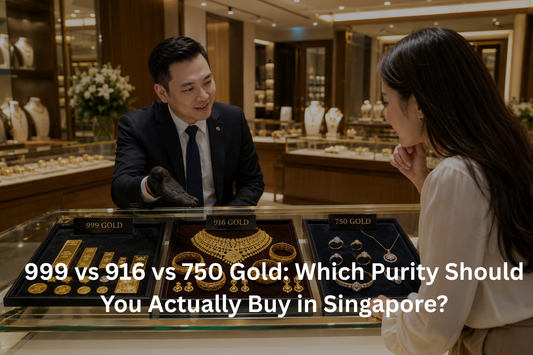
As an alloy with other metals, 916 gold is harder and more durable than 999 gold, which means it resists surface damage better under daily wear and maintains resale condition more reliably over time. 999 gold sits closer to spot price per gram of metal but is more susceptible to condition deterioration that affects resale assessment.
Verifying the Price Structure Before You Buy
What a Transparent Gold Retailer's Pricing Should Show You
A clear price quotation separates the content value from the making charge so you know exactly what each component costs. Without this separation, calculating your break-even price or comparing value across retailers is not possible.
How to Use Transparent Pricing to Compare Retailers
Two pieces at the same total price but different weights have very different investment profiles. Decompose each price into content cost and making charge before deciding. Retailers such as GM Collections, which present content pricing separately from making charges, provide the information structure needed to make this comparison straightforward.
Conclusion
Gold jewellery is not an efficient pure investment vehicle, but it can function as a genuine store of value when the conditions are right. Making charges are a sunken cost that resale does not recover, which means the price must rise by more than the making charge percentage before a seller breaks even. For buyers with long holding horizons, genuine wear or gifting purposes, and a preference for simple designs with lower making charges, jewellery holds value meaningfully over time. For buyers whose primary objective is financial return, bullion and ETFs are more appropriate instruments. The decision becomes clear once the investment equation is understood: total price, content weight, making charge, expected holding period, and resale channel together determine whether this is the right form of gold for your specific purpose.
Tags:
Previous
Gold Price in Singapore 2026: What Drives It Up and Down
Next
What Is 916 Gold? Understanding the Hallmark and What It Means in Singapore
Related articles
-
Sep 21 2026